Graphical Desktops
Sway and GNOME
MNT Pocket Reform ships with two graphical environments called “desktops”. The Debian distribution, which the system on the eMMC is based on, has a number of additional desktops in its package manager (see section “Alternative Desktops” at the end of this chapter).
Sway emphasizes the concept of “tiling”. This means that normally, windows don’t overlap, but instead the screen space is automatically divided to make space for new windows. This desktop consumes minimal system resources, but relies heavily on keyboard shortcuts, which makes it harder to learn.
GNOME features classic overlapping windows, a point-and-click driven interface, and a modern look. In GNOME, you can drag windows to the corners or edges of the screen and they will be snapped. They also have minimize, maximize, and close buttons.
You initially choose between Sway and GNOME in the MNT Pocket Reform Setup Wizard. This choice will be reflected as the default on the login screen, but you can change it by clicking the settings icon after selecting your username (without entering your password) on the GDM login screen.
The Sway Desktop
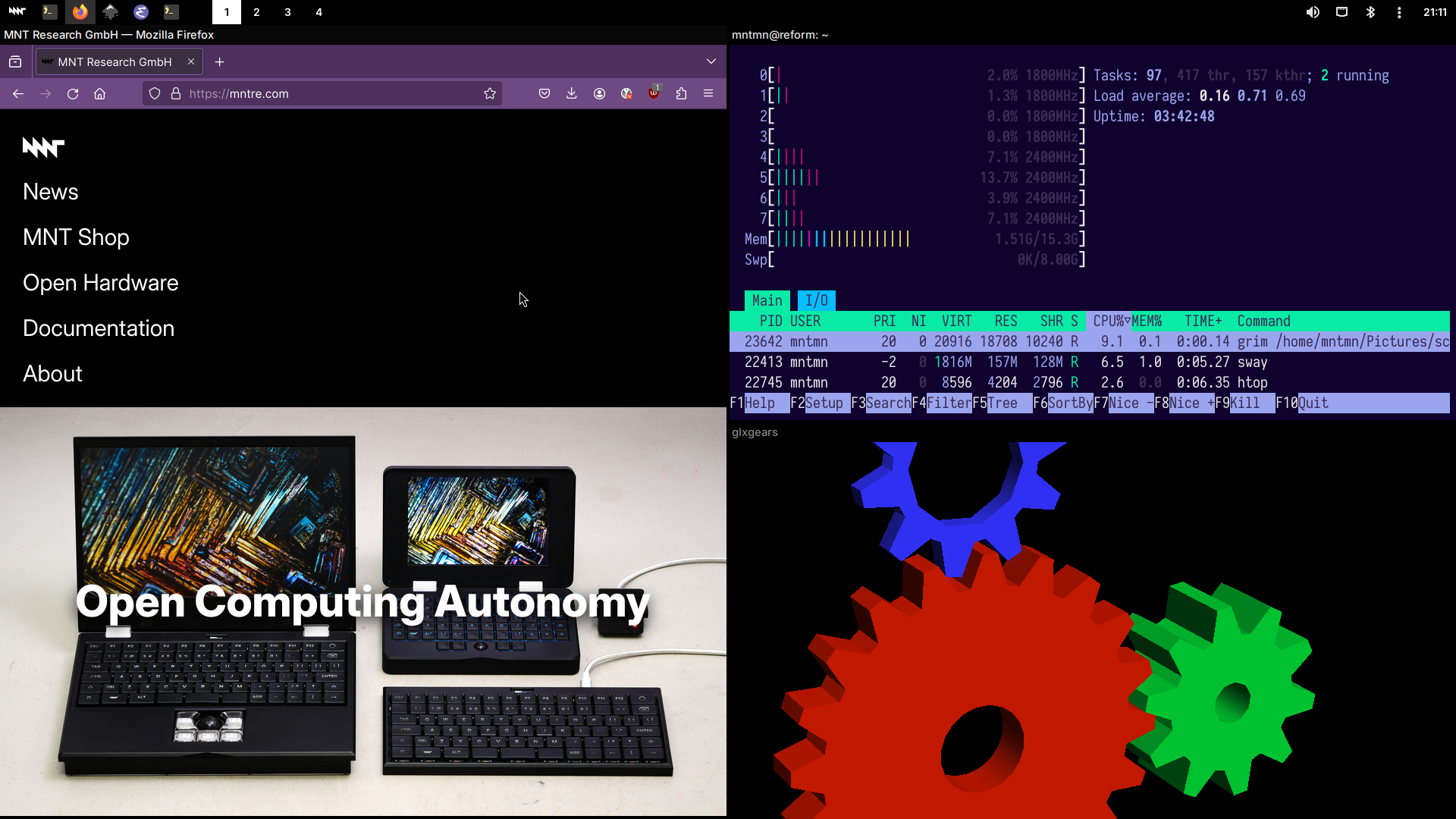
Sway is optimized for use with keyboard shortcuts, most of which are combinations of SUPER [1] and other keys. These are the most important shortcuts:
Key Combinations |
Function |
|---|---|
SUPER+D |
Open the launcher to start applications |
SUPER+ENTER |
Open a terminal |
SUPER+ESC |
Close active window |
SUPER+1… |
Go to workspace 1–9 |
SUPER+SHIFT+1… |
Move active window to workspace 1–9 |
SUPER+SHIFT+S |
Take screenshot (in ~/Pictures) |
SUPER+SHIFT+X |
Take screenshot of an area |
HYPER+SUPER+1 |
Decrease display brightness |
HYPER+SUPER+2 |
Increase display brightness |
HYPER+Trackball |
Change keyboard backlight (roll horizontally: hue;
|
Tiling
You can start a new terminal window by using the shortcut SUPER+ENTER. When you press SUPER+ENTER multiple times to open several terminals, you’ll notice that your currently open windows will be resized to accommodate for the new window. You can switch between these windows by holding the SUPER key and pressing the cursor (arrow) keys in the desired direction.
If you keep adding windows, they will continuously shrink horizontally, but if you would rather have a window split vertically, you can. Use these shortcuts for deciding:
Shortcut |
Function |
|---|---|
SUPER+H |
Split window horizontally |
SUPER+V |
Split window vertically |
Note that the window is not split instantaneously. You’re just telling Sway “The next time I create a window, put it below/beside my current window.”
You may also use SUPER+W to tell Sway to use tabs. You can switch your tab using the same shortcuts for switching between windows. You can end this function by pressing SUPER+E. You can use SUPER+ESC to close the currently selected window.
Launching Applications
Pocket Reform’s Sway desktop includes the wofi launcher, a popup menu for launching an application by typing a part of its name. Press SUPER+D to open the menu. Over time, wofi will remember the applications you regularly launch and will sort them by frequency of use.
Top Bar
Sway on Pocket Reform comes with an information bar at the top of the screen, which is provided by the waybar package. The bar is divided into the following sections:
Section |
Action on click |
|---|---|
MNT Research logo |
Open the launcher |
Icons of running applications |
Switch to application |
Workspace numbers |
Switch to workspace |
Tray icons |
Settings for network, volume, etc. |
Clock |
Toggle date/clock |
You can completely customize the top bar by editing the config file ~/.config/waybar/config and the CSS-based styling file ~/.config/waybar/style.css.
man waybar explains the available configuration options.
Workspaces
If you have a lot of windows open, they might not all fit on the screen at once. For this purpose, multiple set of windows can be arranged in workspaces.
You can change your active workspace with the number keys, for example:
Shortcut |
Function |
|---|---|
SUPER+2 |
Go to workspace 2 |
SUPER+1 |
Go back to workspace 1 |
SUPER+SHIFT+5 |
Move active window to workspace 5 |
You can open different spaces for different programs. For example, you might want to put your code-editing programs in workspace 1, a web browser in workspace 2, and some instant messaging programs in workspace 3.
Display Brightness
With Sway, you can set the display’s brightness using the brightnessctl command or, more conveniently, use one of these keyboard shortcuts:
Shortcut |
Function |
|---|---|
HYPER+SUPER+1 |
Decrease display brightness |
HYPER+SUPER+2 |
Increase display brightness |
Sway Config File
You can tailor Sway’s behavior and keyboard shortcuts by editing the file ~/.config/sway/config or one of the included files in the ~/.config/sway/config.d directory.
All configuration options are documented in the manual page that you can access by typing man 5 sway in a terminal. More information is also available in the Sway Wiki: https://github.com/swaywm/sway/wiki
Some of the most important configuration options are explained in the following sections.
Network, Wi-Fi, and Bluetooth
You can connect to Wi-Fi networks and configure Ethernet as well as VPN connections by clicking the respective buttons in the tray area of the top bar.
On Sway, you’ll see a Bluetooth icon in the tray area of the top bar. This icon is powered by the blueman package behind the scenes and clicking on it with the left mouse button will open the Bluetooth Devices window, where you can search for nearby devices to connect to. Right clicking on a Bluetooth device will give you the options to connect, pair, or get more information. You can also right-click on the Bluetooth icon in the top bar itself to open a context menu with more options, like toggling the Bluetooth visibility of your MNT Pocket Reform, sending files or reestablishing recent connections.
Note that any Bluetooth audio devices, when connected, will appear in Volume Control (started by launching it from the speaker icon in the top bar or manually from the launcher). Here you can choose them as the default output or input device and adjust the volume.
Sound
There are multiple ways to change the audio volume:
Scroll (with the Trackball’s Wheel Mode) up and down while the mouse cursor is hovering over the speaker icon.
Click on the speaker icon in the top bar and select Volume Control. In the Output Devices tab, you can control the volume with the slider in the Built-in Audio Speaker (or Built-in Audio Headphones) section.
To change between the built-in Speaker output and headphones, you can use Volume Control as well. Go to the Configuration tab and select the Profile under Built-in Audio, either MNT Reform Hi-Fi Audio (Speaker) or MNT Reform Hi-Fi Audio (Headphones). The exact names of the profiles can differ depending on your Processor Module.
Keyboard Layout
The keyboard layout is normally configured by the MNT Pocket Reform Setup Wizard. Should you want to configure it manually, you can edit the ~/.config/sway/config.d/input file. For example, the following snippet will change the layout to the EU layout for any connected keyboard:
input * {
  xkb_layout eu
  xkb_options lv3:ralt_switch
}
Trackball/Trackpad Speed
A common thing that people want to tune to their particular taste is the speed of the trackball (or trackpad) on MNT Pocket Reform. For Sway, you could add an input section (or extend the existing one) to the ~/.config/sway/config.d/input file as such:
input * {
  accel_profile adaptive
  pointer_accel 1.0
}
Where pointer_accel can be a number between -1.0 and 1.0.
You can find out about all of the details of Sway’s input configuration by opening its manual page using man sway-input.
External Displays
Some Processor Modules allow you to connect an external display on the HDMI port, but not all of them can drive both the internal and the external display at the same time. If your module supports dual display, plugging in an external monitor should just work. If you want to configure the placement and resolution of this monitor, take a look at man sway-output and create an output HDMI-A-1 section in your Sway config file. Other helpful tools that you can install for these purposes are kanshi and wlr-randr.
You can also use swaymsg to control your displays on the fly or when pressing certain key combinations. The following example script will switch from internal to external display and force a standard 1080p mode:
#!/bin/sh
swaymsg output eDP-1 disable
swaymsg output HDMI-A-1 enable
swaymsg output HDMI-A-1 modeline 148.50 1920 2448 2492\
                                 2640 1080 1084 1089\
                                 1125 +hsync +vsync
The GNOME Desktop
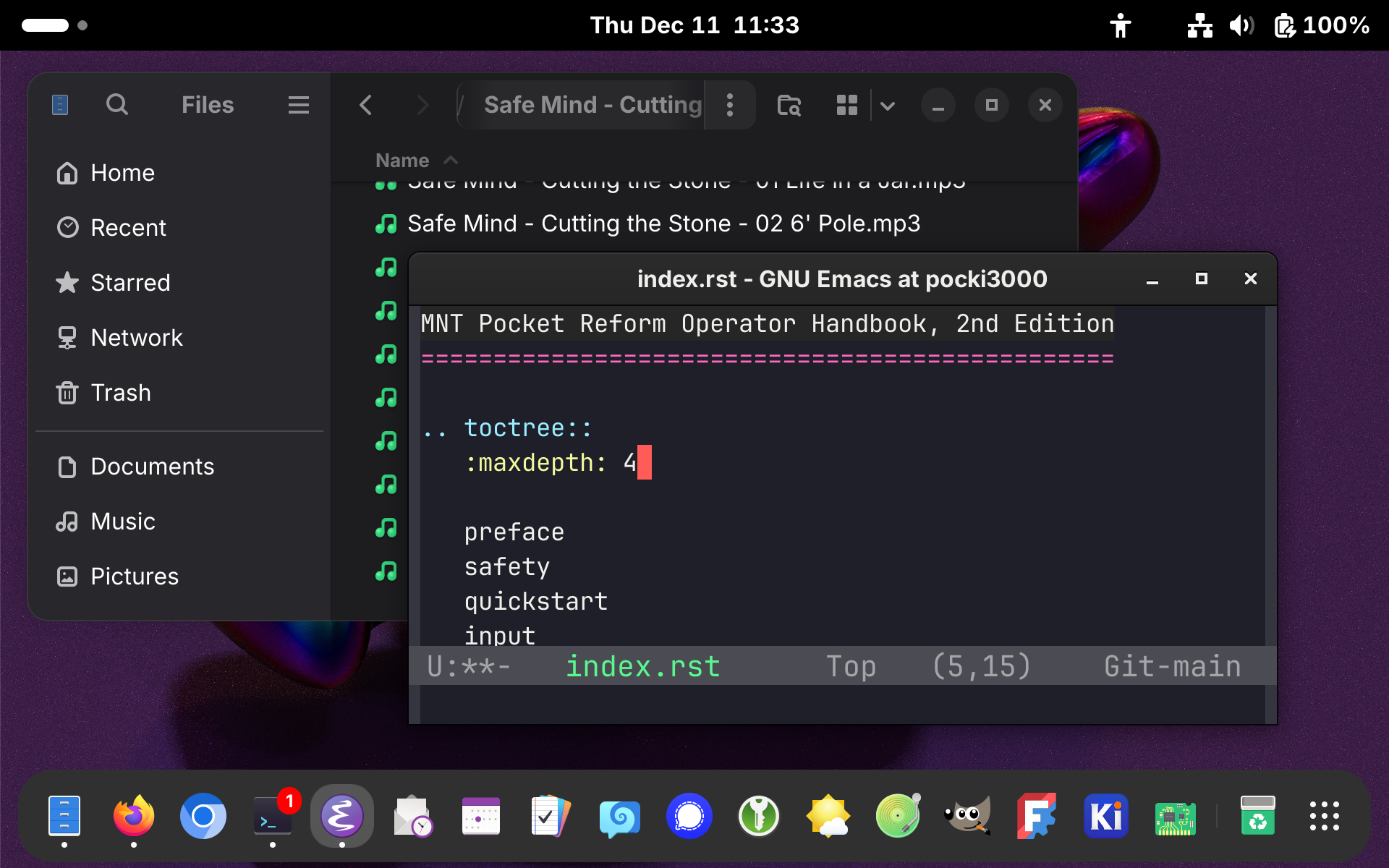
GNOME on MNT Pocket Reform supports a number of customized keyboard shortcuts to speed up working with the desktop:
Shortcut |
Function |
|---|---|
SUPER |
Open Activities overview and launch applications |
SUPER+← or → |
Tile window to left or right |
SUPER+↑ or ↓ |
(Un)maximize window |
SUPER+TAB |
Cycle through running applications |
ALT+TAB |
Cycle through windows of the focused application |
SUPER+ENTER |
Open a terminal |
SUPER+ESC |
Close the focused window |
SUPER+SHIFT+S |
Take screenshot (in ~/Pictures) |
SUPER+SHIFT+X |
Take screenshot of an area |
SUPER+SHIFT+R |
Make a screen recording of an area |
HYPER+SUPER+1 |
Decrease display brightness |
HYPER+SUPER+2 |
Increase display brightness |
HYPER+Trackball |
Change keyboard backlight (roll horizontally: hue;
|
To speed up your window juggling, you can move windows not only by dragging their titlebar, but also by holding SUPER and dragging (with the left trackball button) anywhere in a window. To resize the window from any point, you can hold SUPER and drag on the window with the right trackball button.
Launching Applications
With GNOME, you can start an application using the dock (the row of icons on the bottom of the screen, also called Dash) or the Activities overview (opened by pressing the SUPER key). You can find an application by typing a part of its name in the overview. You can pin a frequently used application in the dock by right clicking its icon and choosing “Pin to Dock”.
Top Bar
The top bar in GNOME has 3 major sections:
Left side: Workspaces indicator. If you have multiple workspaces configured, it highlights which one is currently active. Clicking on the indicator brings up the Activities overview.
Middle: Date and time. Clicking on them opens a dropdown with a list of notifications and the calendar. You can set up the calendar using the Evolution application (an email client with built-in calendaring and task management) or the more minimalistic Calendar application.
Right side: Accessibility menu, and a combined indicator for network, volume and battery status. Clicking this indicator brings up the System Menu.
System Menu: Volume, Brightness, Network
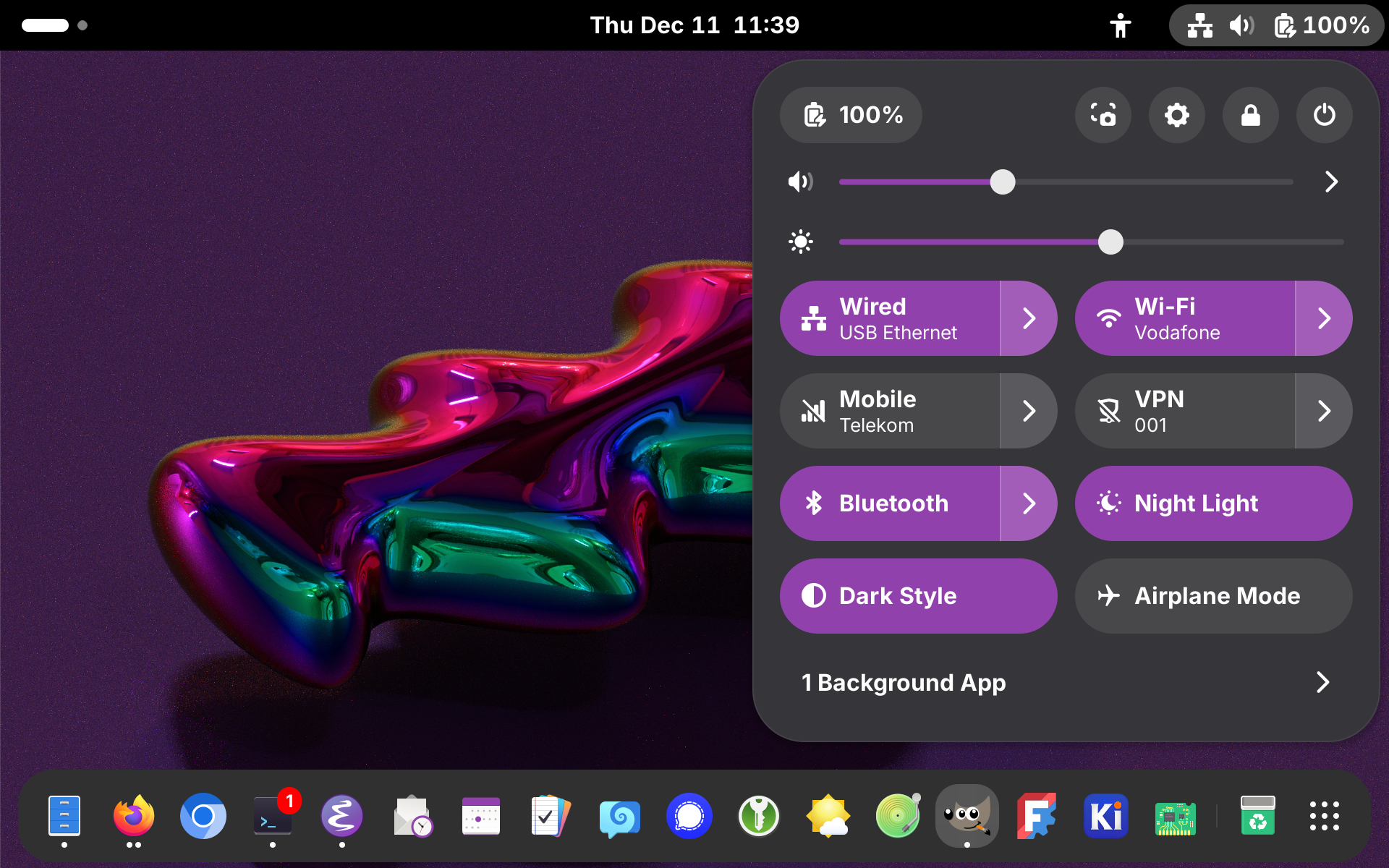
The System Menu lets you control all important settings of the system. From top to bottom:
Buttons (from left to right): - Battery status - Taking screenshots - Settings - Lock screen - Power off / Reboot / Log out
Volume slider
Display brightness slider
Quick Settings
The Quick Settings are a mix of buttons that control network interfaces like Wi-Fi, Ethernet, Cellphone network, Bluetooth. You can connect to your respective networks and devices here, or toggle them on and off. In addition, there are toggle buttons for the user interface’s Dark Mode, Airplane Mode (which shuts down all radio interfaces) and Night Light (to automatically set the display to a more eye-friendly hue at night).
Sound
Beyond adjusting the audio volume, you can also switch between the built-in speaker and headphones (or USB and Bluetooth audio devices) by clicking the arrow icon right next to the volume slider in the System Menu. From there, you can also reach the more detailed Sound page of the Settings application.
Settings: Keyboard Layout, Displays and More
All of the Quick Settings can be configured in more detail in GNOME Settings (also called gnome-control-center), an application that you can access by clicking the gear icon in the System Menu. Alternatively, you can find it as a normal application in the Activities overview by typing “Settings”.
In addition to networks, you can configure almost all important aspects of the system here. Some of the most commonly needed settings are:
Keyboard: The keyboard layout is initially configured by the MNT Pocket Reform Setup Wizard, but you can change it here.
Mouse & Touchpad: Change the speed and behavior of the trackball (or external mouse/touchpad).
Sound: Change audio devices, volumes, and the alert sound.
Displays: Configure display scale and external displays.
There are many additional, hidden settings that don’t appear in the GNOME Settings application. You can explore them using gnome-tweaks or the gsettings command-line tool.
Alternative Desktops
You’re not limited to the desktop options that we include with the System Image. You can install any desktop environment that is packaged in Debian. For example, you can install KDE by entering sudo apt install kde-standard, or Xfce4 by entering sudo apt install xfce4 in a terminal. To switch between desktop environments, click on the gear icon on the GDM login screen after selecting your username (before entering your password).
Please note that installing a heavyweight desktop environment like KDE will affect your existing GNOME installation too, by adding additional services, changing icons/fonts/cursors etc. So this isn’t without risk (or at least some cleanup work if you later decide to go back).